
Site Hits: 36,616,173
Site Hits: 36,616,173









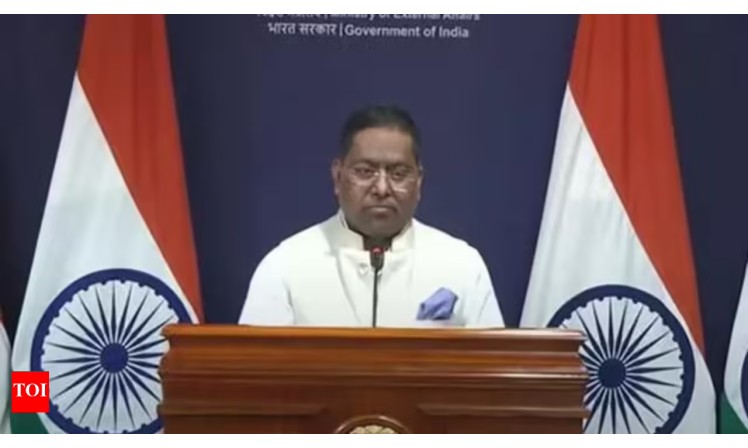
Image Source: Agencies
Aug 22, 2025: Nepal's House of Representatives has been energized by the recent agreement between India and China to construct a trade route along the Lipulekh pass. This has brought the opposition and ruling parties together. During Thursday's session of the House of Representatives, lawmakers from both the opposition and ruling parties drew the attention of the government to the latest agreement signed between India and China.
Gagan Thapa, a parliamentarian from Nepal's largest political party, the Nepali Congress, objected to the unilateral move by India and China, calling it unacceptable and objectionable.
"In our absence, we read, listened to, and were aware of an agreement regarding our land that our two neighbors, China and India, had made. The Nepali Congress Party expresses its serious disagreement with this behaviour of our two neighbours. This is objectionable, unacceptable," Thapa, also the General Secretary of the Nepali Congress (NC), said.
India and China have agreed to reopen border trade through Limpiyadhura's Lipulekh Pass, 56 km from Nepal's western border. The agreement was made during Chinese Foreign Minister Wang Yi's visit to India earlier this week.
Both countries agreed during a meeting between the External Affairs Minister S Jaishankar and the Chinese Foreign Minister Wang Yi. Point nine of the joint communique mentions the resumption of border trade.
"Both sides agreed to the re-opening of border trade through the three designated trading points, namely Lipulekh Pass, Shipki La Pass and Nathu La Pass."
Mahesh Bartaula, Chief Whip of CPN-UML (Communist Party of Nepal-Unified Marxist Leninist), also objected to the agreement between India and China via Nepali land without consultation when he addressed the parliamentary session. "The CPN-UML parliamentary party would strongly oppose the agreement reached between them (China and India). We want to express our disagreement with it. In terms of population, economy, and geography, a country can be small or big. But it cannot be small or big in terms of self-respect, independence and sovereignty of the country. "We will oppose and counter any activity that affects our country's freedom and independence," Bartaula, the chief whip of the UML led by Prime Minister KP Sharma Oli, stated. Similarly, CPN-Maoist Centre chief whip Hitraj Pandey drew the government's attention, saying that the agreement between China and India is hurting Nepal. He objected by saying that the Maoist centre has drawn serious attention to the agreement on border trade without even informing Nepal.
"We express our opposition to this agreement, which was made without even informing our nation about the lands listed in the constitution—Lipulekh, Kalapani, and Limpiyadhura. "We reject it," Pandey stated. The agreement comes ahead of Prime Minister KP Sharma Oli's visits to India and China--he will first attend the Shanghai Cooperation Organisation summit in China from August 31 to September 1, then proceed to India for an official visit starting September 16.
Nepal's Ministry of Foreign Affairs on Wednesday objected to the agreement of India and China to open a trade route via Lipulekh, asserting a claim over the land. The Ministry issued a statement in which it objected to China and India's unilateral move and asserted its claims to the land. Meanwhile, India on Wednesday rejected Nepal's territorial claims over Lipulekh Pass, stating that the claims are "neither justified nor based on historical facts and evidence".
The Ministry of External Affairs (MEA) emphasised that India remains open to constructive interaction with Nepal to resolve outstanding boundary issues through dialogue and diplomacy.MEA spokesperson Randhir Jaiswal reiterated that India's position on the issue remains consistent and clear, emphasising that border trade between India and China through Lipulekh Pass has been ongoing since 1954.
The ministry said that the claims made by Nepal are neither justified nor based on historical facts and evidence." Our position in this regard has been consistent and clear. Border trade between India and China through Lipulekh pass had commenced in 1954 and has been going on for decades. This trade had been disrupted in recent years due to Covid and other developments, and both sides have now agreed to resume it," said Jaiswal.
"As regards territorial claims, our position remains that such claims are neither justified nor based on historical facts and evidence. Any unilateral artificial enlargement of territorial claims is untenable. India is still open to constructive dialogue and diplomacy with Nepal to resolve agreed-upon outstanding boundary issues. Notably, in 2023, China released a new map showing Lipulekh, Kalapani, and Limpiyadhura as part of India.
Nepal maintains that Lipulekh, including Kalapani and Limpiyadhura, belongs to Nepal according to the Sugauli Treaty of 1816.
India's position is that the Kalapani region, including Lipulekh and Limpiyadhura, is part of its territory. This claim is based on India's interpretation of the Sugauli Treaty of 1816, which defined the border with Nepal based on the Kali River. India maintains that the river originates at the Kalapani village, while Nepal argues it originates further north, at Limpiyadhura. This difference in interpretation leads to the disputed territory.









Leave a comment: (Your email will not be published)